A special relationship
One afternoon, many years ago, I was minding my own business on the patio lawn chair, when a spider leapt over the chair back and, for a moment, stared. Small, hairy with stubby legs, it moved about in short bursts and miniature jumps, stopping to turn left, then right, its movements abrupt, angular. Unlike the conventional notions of a spider, it had no menacing stillness or elbow-jointed walk. How original, it seemed. I could see its eyes, and it was looking at me, almost puppy-like.
Heading in my direction, the spider popped forward—pop! pop! When it got within a few inches, it stopped and gazed up, with its unblinking, lidless eyes. There was something about this creature. Dare I say this spider appeared… curious. I put my finger down, right next to it. And the spider jumped on.
Funny.
 “Hey,” I said to Diane, who sat across from me in the other lawn chair, “look at this spider.” The spider was dancing a jagged half-circle on my finger.
Diane glanced at me and half smiled, ignoring the spider. She then more or less rolled her eyes, subtly, as was her style. Which shouldn’t have surprised me. I have a history of sharing observations on all manner of creature crossing my path: the flight patterns of flies and how to interrupt them (if they happen to be circling your head); the odd colors and lethargy of certain beetles that make their way into the house; the various hues of ladybugs; and so on. Diane had long since catalogued and binned this behavior, with only the slightest barb attached: .
“Hey,” I said to Diane, who sat across from me in the other lawn chair, “look at this spider.” The spider was dancing a jagged half-circle on my finger.
We motored out past the breakwater as the first light began to stain the horizon in shades of rose and gold. Manuel did not speak much. He was listening, he told me later, to the water, to the wind, to the birds that circled overhead. These were the signals that told him where the fish were, that guided him to the spots where his father had fished, and his father's father before him. The knowledge was not written down. It was in his hands, in his bones, in the particular tilt of his head as he scanned the surface of the sea.

Manuel Vazquez mending nets at dawn. Photograph by Marcus Chen.
“Colin’s special relationship to bugs.”
And that was that.
The writer Virginia Woolf apparently had something of a special relationship to bugs, as well, as exhibited by her contemplation of a moth fluttering on a windowpane.
Moths that fly by day … are hybrid creatures, neither gay like butterflies nor somber like their own species. Nevertheless the present specimen, with his narrow hay-colored wings, fringed with a tassel of the same color, seemed to be content with life.
spineless
Spiders aren’t actually a bug, of course. And neither is a jellyfish, for that matter. Nor is a dragonfly. Rather, all fit more or less nicely into one abstract classification. Invertebrates. According the Oxford English Dictionary, we are faced with the following:
\(ˌ)in-ˈvər-tə-brət, -ˌbrāt\. An animal without a backbone or spinal column.
Yet, there’s more to the definition, and it’s telling. These animals get a fairly bad rap from us, the human species. Consider, as illustration, the second definition found in the dictionary:
Invertebrate. 2. A person without strength of character or principles.
To wit: spineless.
But I’m going on too much. Don’t listen to me, I know next to nothing about invertebrates, or bugs or spiders, other than what I’ve seen and a few clever notes. For a truly special relationship to invertebrates, you need to talk to Candace Fallon.
Ahem…..
“My son says he wants to be a programmer. I asked him what a programmer does. He said he will sit in a room and talk to a machine all day. I told him he already talks to reindeer, and at least reindeer talk back.”
cowgirl spider
“I think that’s part of the fun of it,” says Candace. “When you start noticing them. I mean, they’re one of the most abundant life forms on the planet.” True that. Invertebrates are everywhere; some 99% of known living species belong to this category. “There’s so many things you can observe about them, watch about them. And you can go and seek them out wherever you are.”
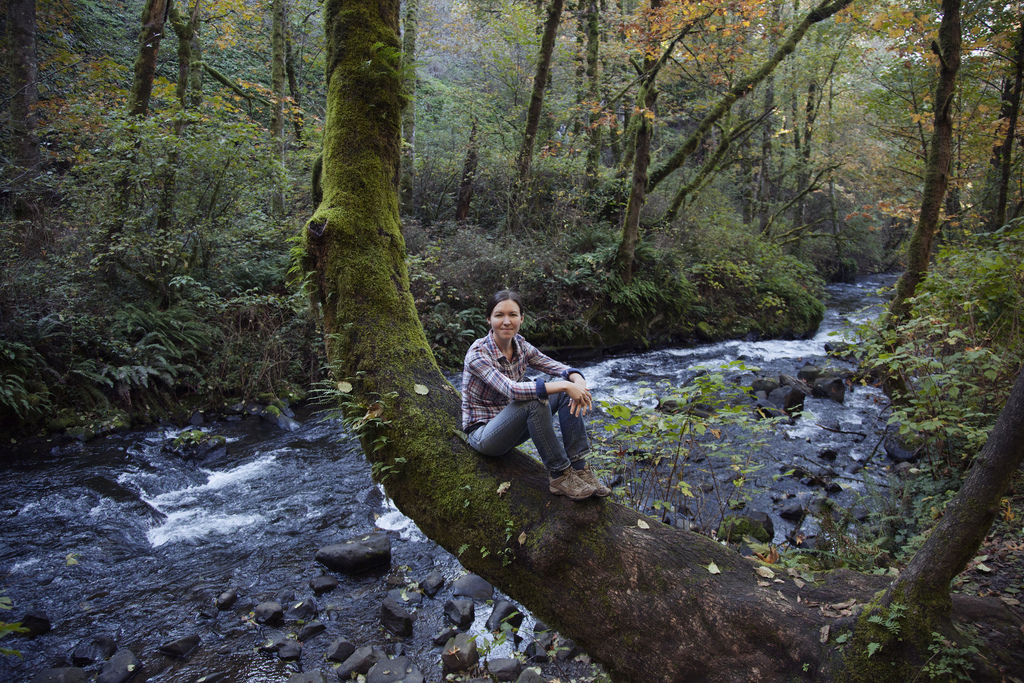
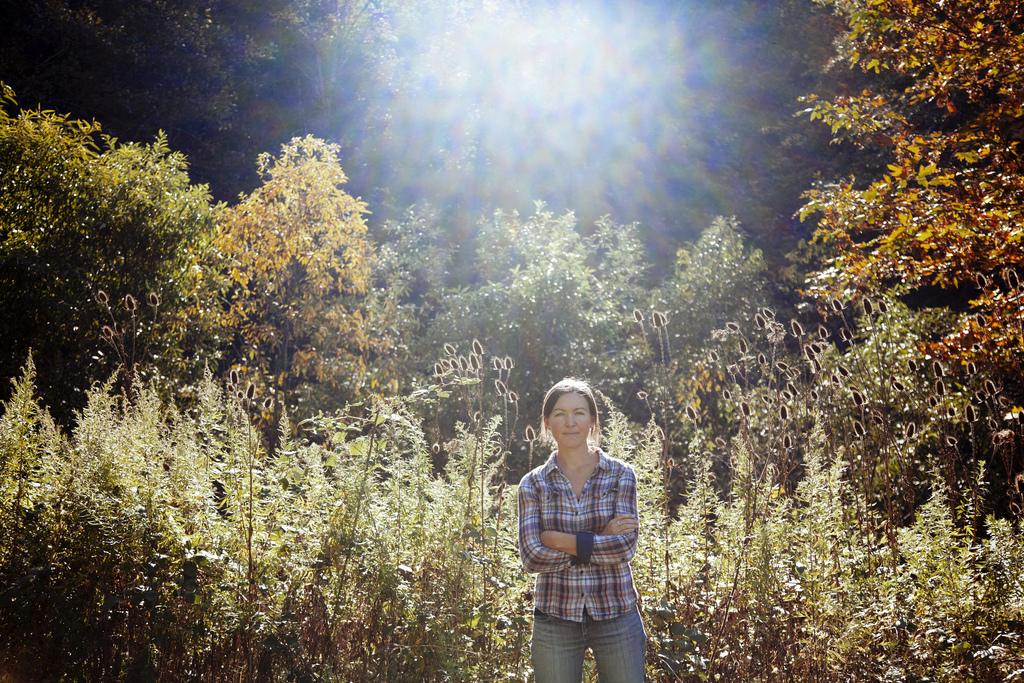
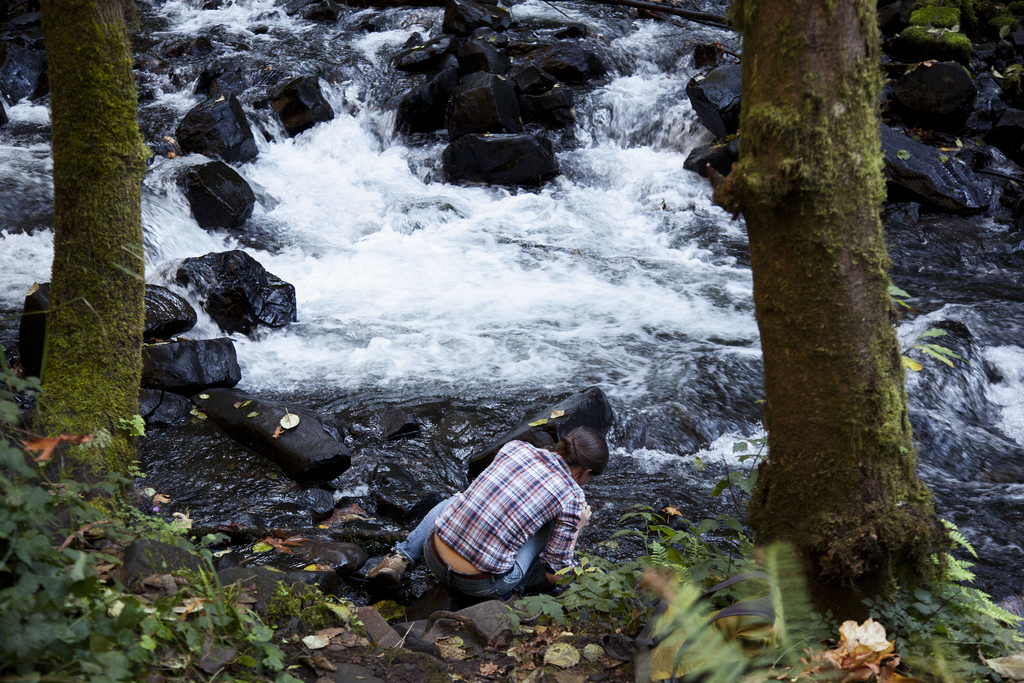
Click any image to view the gallery.
Candace and I are knocking back pints of IPA in a busy pub, mostly discussing the land-based invertebrates, Candace’s bailiwick. (Invertebrates are likewise bountiful in rivers, lakes, and the sea.) It might be the beer talking, but I have a niggling question. I feel bad asking an invertebrate expert this question, for it’s clearly objectifying—but I ask anyway..
“So, are there any invertebrates that are just too strange—even for an invertebrate?”
Candace pauses before answering, weighing her response.
“…I feel like they’re all kind of crazy and weird,” says Candace. “When you think about it, their behaviors are really strange.”
“Like what?”
“It mostly revolves around their mating practices….”
“Like devouring each other. That sort of thing…”
“Yeah. But that’s one of the reasons they’re so cool.”
She then steers another direction, likely realizing that mating stories are common, and so say little. Instead, she lays out a description of what could only be described as a championship rodeo spider.
“There’s this one spider called the Bolas spider. The female will attach a single strand of silk between two things, and she goes to the middle of it. Then, she creates this kind of lasso. But it has a sticky ball at the end. And she waves it around the air, until a moth comes along—and she nabs the fly! It’s like this crazy cowgirl spider.”
Candace takes a sip of beer.
“Behaviors like that are pretty cool,” she continues. For instance, there are ants that herd aphids, the way farmers herd cows. “The ants take care of the aphids, protecting them from predators, checking on them. In return, the aphid excretes a sweet substance called honeydew. It’s essentially aphid excrement. But it’s like candy for the ants.”
I look around, this way and that. The pub is noisy and full of laughing and talking people, and the volume suddenly peaks, a real jolly decibel. The flights of imagination, triggered by talk of foreign animals, the invertebrates, has got me reimagining the familiar ones, the humans. The surrounding tables of laughing and gesticulating people strike me as increasingly insect-like. Gangly appendages flail about, mouths open and close. The room fills with a frenzied buzzing, not unlike an aggrieved beehive, transgressed by a gormandizing bear paw. All these pub creatures, moreover, are gathered around vessels of colored nectar, some golden, some clear, demonstrably exciting the creatures; vessels of nourishment over which each animal hovers, never straying far without returning, posthaste.
What it must be like to eavesdrop on the two of us, I can only imagine.
butterflies in the rain
Candace’s natural enthusiasm is infectious; it’s easy to get pulled in. But it also unearths an uncomfortable notion. How little most of us know, and how little interest we take in, what is, essentially, a fundamental the truth of the world. We are not alone, by any stretch of the imagination.
As a child, I recall how fascinating other creatures were, to me and to other kids. One year, a book came my way, called Where Do Butterflies Go When It Rains? The question gripped me. Turning the pages, I couldn’t wait to find out. Before that book, I’d not thought butterflies went anywhere, there were simply here. It was thrilling to wonder. Yet, as adults, most of are far quicker to whip out the bug spray than to wield curiosity. Candace sighs.
“It’s really interesting how we have this totally different mindset about how we treat insects.”
save the mosquito
Virginia Woolf continued to watch her moth.
The same energy which inspired the rooks, the ploughmen, the horses, and even, it seemed, the lean bare-backed downs, sent the moth fluttering from side to side of his square of the windowpane.

More than just a casual observer, Candace holds degree in environmental science, and has maintained a personal and professional interest in invertebrates, in one form or another, for much of her adult life. These days, she can be found at the Xerces Society for Invertebrate Conservation, a worldwide blending of scientists and citizenry, aimed at protecting invertebrates and conserving their homes and haunts.
Candace is not some solitary, crazed bug lover. There are a lot of other actively interested folks, even people who are not professional scientists or holders of zoological degrees. Some of these are citizen scientists, people who increasingly contribute to a body of knowledge that help professionals in many fields, from ecology to sociology to all manner of animal crowdsourcing. Whether it’s counting dragonflies or birds or crowds of people, recording plants and animal cycles, or documenting what plants bloom when and where, citizen scientists are playing a role. Opportunities exist at Xerces for citizen scientists, ranging from counting butterflies to pond watching for dragonflies to photographing bees. Among her other duties, Candace works with the Xerces citizen science programs.
To an outsider, however, the protection of invertebrates can sound odd, like it’s the bleeding heart bug squad. But with just a bit of curiosity, delving into the connections within the natural world, it all comes together nicely, and the purpose of such a group becomes clear. Indeed, it makes perfect sense
Somewhat paradoxically, less savory examples than butterflies are a perfectly good place to start an inquiry. Sometimes it’s necessary to protect, say… mosquitoes. No, no: it can’t be. To the layperson, this can sound simply bizarre. Think about it, however. Mosquitoes on lakes or ponds are often fish food. Without the mosquito, there is no fish food. No fish food, no fish. The consequences ripple out. Without the fish, there’s no whatever is eating the fish, which can be any number of animals, including humans, for whom a shortage of fish is no small matter, either. While the natural world can appear straight forward as one strolls along the city or the country, complex patterns exist everywhere. Nature is a mind-boggling interlocking puzzle.
Or, if you’re not careful, it’s a house of cards.
 “The more you know,” says the smiling Candace, “the more fascinating it becomes.”
losing the popularity contest
Although she goes a bit red in the face when she admits to it, butterflies are one of her favorites, and butterfly conservation has been her domain at Xerces. Butterflies are an easy sell compared to other invertebrates, being legendary, a thing of myth, a metaphor of beauty and change, unlike other lesser known or nearly invisible species, without supporting fables, such as aquatic snails or the unpopular mosquito.
“I do like butterflies,” she says. “Funny, I used to distance myself from butterflies, because they are so easy to like. And I wanted to be this champion for lesser-loved creatures.” She maintains affection for all manner of invertebrates, and has a soft spot for certain poisonous spiders. “But I just kept getting these jobs working with moths and butterflies. I am definitely a big fan…”
Her chagrin has powerful foundation. Popularity plays an unfortunate role in the kind of attention a creature gets, positive or negative. Invertebrate survival sometimes depends almost entirely on human caprice, whether or not “we like them.” Often based solely on their look.
During and since the Deepwater Horizon oil spill in the Gulf of Mexico, media and research have focused on whales, birds, and dolphins, consistent winners in the popularity contest. Yet, according to Candace, large mammals represent less than two percent of all marine life. We have next to no idea how many myriads of sea creatures—anemones, starfish, corals—are living poorly or dying in the oil sodden gulf. Once again, negative effects on invertebrates, in this case ocean invertebrates, can have a range of cascading consequences, rippling out toward other ocean life.
“That’s the biggest thing, if you don’t know about something, you don’t understand it, you’re less likely to be interested by it, or respect it as another animal.” Candace’s sincerity is real and unmistakable. She is a terrific spokesperson for these creatures, which otherwise have no voice.
She returns to the subject of butterflies, with a confession.
“Butterflies are awesome to work with,” she admits. “Because, for the most part, they are only out between 10 a.m. and 5 p.m. They come out when it’s sunny. Or when it’s sixty degrees. They don’t like rain. Or cold.” They have to be warmed up before they can even fly.
I know just how they feel.
counting monarchs, herding cats
Counting butterflies may sound like the punch line to a joke, but it is more difficult than amusing. Candace knows, she spent the winter months in California counting Monarchs. While there can be a ton of them in one place, which is hard enough to count, requiring estimation techniques, butterflies also keep moving. For the butterfly counter, it’s visual herding cats.
“It can be hard. There’s so many of them that you have to count small areas—and extrapolate out.”
The Pacific Northwest, where she usually works, is not super diverse, in contrast what it would be like to study species a place like the tropics, where the variety would be daunting. However, while less diverse in species, the numbers of subspecies in this region do make the labor tricky. And, Candace informs me, it keeps things interesting.
Subspecies can be subtle variations on a more common pattern, making identification difficult. As well, limited are the places where many subspecies are found. Locating them has a lot in common with finding a needle in a haystack. That’s all part of the interest. But an entire year can go by without spotting a particular group.
“Of all my surveys, I don’t think I’ve found my target species, yet,” says Candace with some exasperation. Patience is everything. “It can be a bummer.”
Yet when you do having a sighting, she says: “it’s awesome!” On a recent trip with a coworker to a Mount Hood site, they spotted the western bumblebee, which was on the coworker’s survey list at all four sites.
…By the way, when it rains butterflies hide in the umbrage.
speed-dating a famous tree
Virginia Woolf watched her moth to its end.
When there was nobody to care or to know, this gigantic effort on the part of an insignificant little moth, against a power of such magnitude, to retain what no one else valued or desire to keep, moved one strangely. Again somehow, one saw life, a pure bead.

It’s all about relationships. Our relationship to the invertebrates, invertebrates’ relationships to other plants and animals, the relationships between insects and flowers, and so on. They exist, whether or not we acknowledge them or not. Candace tells a poignant story about one such relationship.
Joshua trees thrive in only a few places. According to Candace, they are pollinated by a single type of moth, the Yucca moth. The Yucca moth is the only known pollinator that appears to pollinate on purpose, rather than incidentally, such as when bees brush up against a flower, as a part of their visit to collect nectar and pollen. Female moths collect Joshua tree pollen with unique tentacles, and carry it to the next flower to be deposited. Since it is the only pollinator of the tree, if that moth dies off, so too go the famous trees and their Dr. Seuss-like desert silhouettes. Like love, this relationship cuts both ways. The Yucca moth only lays its eggs in the Joshua tree’s flowers. If the tree goes, so too goes the moth.
Of course, while many relationships in nature are give and take, making for a nice love story, some are dissembling. The Calypso orchid, Candace informs me, is able to trick insects to its flower, and thereby get its pollen spread—without offering a thing to the insect in return. At least that we know of.
Everywhere you go, relationships are complicated.
the exterminator
“I was just like any other kid,” Candace concedes. All the same, she had a pet beetle. For a while.
“I named him The Exterminator. I don’t know what kind of beetle it was—but it was big!” She laughs loudly. “I would take it out and try and play with it, like a normal pet. It would fly around!”
Needless to say, it didn’t bug her at all.